From “Discussion” to Decisions: How We Helped the Executive Team of a Top 10 Fundraising Platform Double Decision Effectiveness
CASE HIGHLIGHTS
We partnered with the executive leadership team of a leading fundraising software organization to transform how they focus, decide, and execute on the next phase of organizational growth. With our executive team coaching, the team aligned on a shared purpose, clear decision rights, and a macro-level enterprise focus. The result: a team united in the strategic direction, with sustainable habits for how they decide and work together to execute it.
The Situation
Scaling Team Performance to Catch Up With the Growth of the Business
A fast-growing fundraising software platform had scaled its workforce by 450% in six years. While that growth was a win, it came with what the executive director called "organizational debt": roles that had grown faster than they'd been clarified, habits built for a smaller company now stretched thin, and a newly formed executive team driving major strategic initiatives while still solidifying as a true enterprise team. They'd led the company through the hardest growth curve of its life, but now they were at a new inflection point — the board was demanding a strategic change in the platform's core direction that the executive team couldn't agree on.
Underneath the strategic pressure was a more human problem. Strong personalities were clashing in ways that kept the team in churn about the direction they should take, and the executive director was wrestling with their own need to stop holding all the decisions and genuinely trust the team to decide and lead collectively.
To face the challenges before them, the executive team knew it was time to pay down the debt and invest in becoming a more cohesive and collaborative team.
They hired us to help them:
Turn conflict into cohesion before it cost them key talent and the strategic initiatives the business needed to win.
Operate with more enterprise-minded interactions over functional friction so the best ideas, trade-offs, and decisions for the whole business could come forward.
Our Solution
Building the Executive Team Behind the Business
We partnered to deliver our executive team coaching solution, working with the team over eight months in a three-pronged approach that blends focused development work with coaching inside the team's real, live work — because practice on the field of play has the highest potential for change that sticks.
We started with clarity
The first two months were focused on helping the team get clear on the areas creating the most friction and what would be the biggest game-changers for their performance.
Using our proprietary team assessment process, we helped the team create a shared, honest picture of how they were working together — where they had strengths and the biggest opportunities for improvement — and space to talk about it openly. From there, the team aligned on these three growth areas to address:
Who they needed to be and how to engage as an executive team
What they should be working on together and at what altitude
Who made decisions and how they were made

Then, Coaching the Team Into New, More Productive Patterns
Unproductive team habits don't form overnight, and we knew the transformative change the team was after would take a more robust approach than a one-time hit.
We embedded with the executive team for the next six months, coaching them through three targeted sprints tied to their three growth areas, with a customized team development plan that included:
Skill-building sessions to train the team on simple, practical teaming tools leaders could use immediately
Facilitation to help the team create shared operating assets for how they work together
Team coaching in the real work of weekly team meetings to interrupt old patterns and reinforce the new ones
Spot executive coaching/advisory for team members navigating specific relationship friction
While supporting the leader’s shift from holding all the cards to shared ownership with the team to drive success
At the same time, we worked with the Executive Director in one-on-one executive coaching to help them navigate their own leadership shift from holding all the ownership to building it collectively within the team.
The leader’s ability to hold the team more accountable - to work out conflict that disrupted the team and make decisions collectively - was a change just as core to the outcome as anything the team did together.
We wrote more about why this layered approach with real-time team coaching inside real work is a more powerful way to shift team performance than one-off trainings and team offsites alone. If you’re curious, check out the article here , “How Common Fixes for Executive Team Misalignment Meet and Miss the Mark.”
The Result
More Effective Teaming: Faster Decisions and a Higher Strategic Altitude
After eight months of laser focus on growing the team's effectiveness, the executive team reported meaningful gains across all three priorities, with the biggest shift in decision clarity and decision velocity.
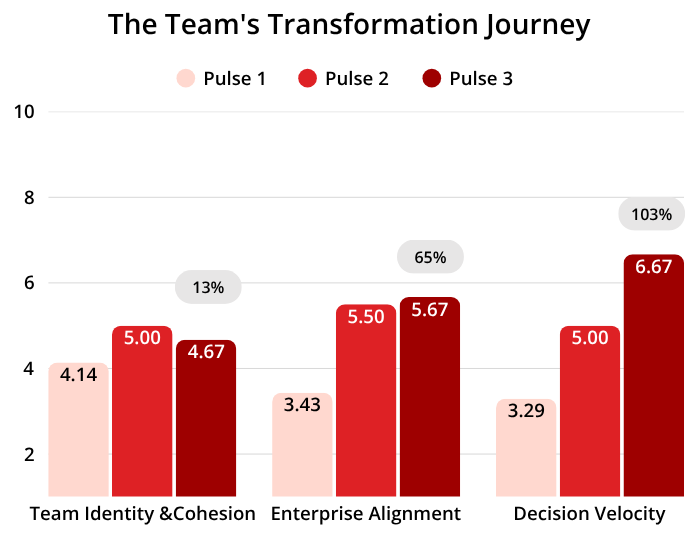
Note: Data reflects anonymous executive team pulse checks conducted at the start, midpoint, and close of the engagement. Percentages indicate total net growth from start to close.
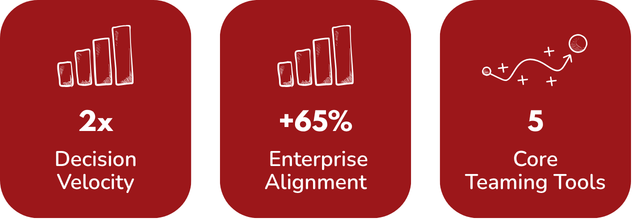
Decision-making velocity: doubled
The team went from carrying unmade decisions on the agenda meeting after meeting to making them — and not re-litigating them in closed rooms after the fact if they didn't like the call.
Meetings became more productive, with one leader saying one of the biggest outcomes was:
“The meeting framework has allowed us to quickly get aligned on what we're hoping to walk away with, what the purpose of a discussion is, who will or how we will be deciding on an issue, and has led to us having greater clarity and purpose in our conversations”
And they got clear and faster at making the decisions that mattered and sticking to them as a unified front outside of the room. Team members put it this way:
“We have been able to move forward challenging (but time-sensitive) discussions which used to derail us regularly”
"It has helped us move from discussion to decision, and focused everyone on asserting a choice — not just 'thoughts."
Enterprise alignment and focus: up 65%
The team got sharper about what belonged at the executive table versus inside individual functions; and what priorities they needed to align and execute on, together.
Some leaders put “the big win” resulting from team coaching this way:
“Our strategic plan is more strategic (versus ops/tactical), more informed by true subject matter expertise, and more shared across leadership.”
“We've directionally come together about where the org should go in the year ahead…it's been gratifying to see thinking start to align on the big picture topics.”
And others tied their improved team performance directly to the bandwidth for strategic work in their meetings.
"We've had more focus on the strategic leadership level."
"I think we've gotten faster at making operational-level decisions, which leaves us more time and space for the strategic areas we should be focusing on."
Team identity and cohesion: up 13%, the shift was bigger than the number alone
We helped the executive team do the foundational work of defining who they needed to be, then increasing their commitment to be "all in" with one another.
Shared purpose and trust are the foundation that teaming rests on, which is why this number carries more weight than it might suggest. Some team members put it this way:
"We co-created this [our team purpose statement], and it made explicit what had been only partially implicit — a shared expectation and commitment to behave like a unified home team."
“I appreciate that we've gotten to spend a lot of time together working through challenges as well as getting to know one another better and really move towards a "team" vs. just a group of department leaders coming together.”
A Teaming Toolkit Built for Stronger Performance
Through our work with them, the executive team built their teaming toolkit — a shared purpose statement, agreed norms, clear decision rights, decision-making protocols, and a strategic focus for the next two years — a playbook for how they'd agreed to operate and run their new, more productive patterns.
The Teaming Edge
Our work with this fundraising software company's executive team shows what's possible when a leadership team stops tolerating friction that slows its execution and starts working as one team, fast enough to keep up with the business they're running.
Through our executive team coaching solution, we helped the leaders get on the same page for the next phase of the organization's growth. They got clear about who they needed to be and how they needed to operate at an enterprise level to steer the organization into a new strategic direction. And they built the trust and decision-making practices needed to execute it faster.
If your senior team needs to operate with more cohesion and alignment to keep pace with business demands, Bamboo Teaming can help. Let's talk: schedule an introductory call to get to know us and explore what's possible. https://www.bambooteaming.com/contact